Sunday, 9 October 2011

Bid for your supper


Hopefully you are all saving the left over portions from meals and if they are not incorporated in the next day’s menu then they are being frozen.
So what to do with a family to feed and lots of individual portions?
Well, if you serve them up to people’s choice you have the extra work of the individual servings. Extra dishes to wash up, etc..
Probably there will be certain dishes that are more popular than others. This could lead to arguments.
So how do you come out of the situation on top?
Why not auction off the dishes in exchange for chores?
Write out a list of the food available and then take bids for each. Someone might be happy to clear the dishes and wash up for their choice. Another might be happy to sort out the recycling, mow the lawn or clean the windows.
You might find a regular weekly evening for leftovers?

Saturday, 8 October 2011

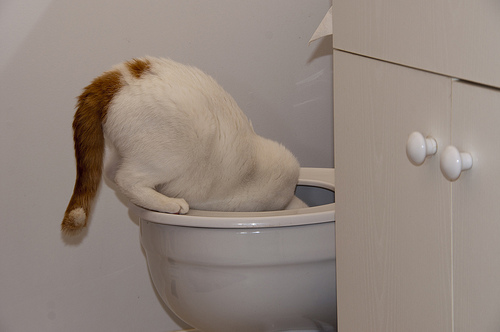
Five alternative toilet cleaners


Before you tip flat Cola down the sink, why not use it as a toilet cleaner? Pour into the bowl and leave overnight to remove lime scale. Even if you don’t have flat Cola, a fresh bottle of an economy brand is not only cheaper than bleach but also more environmentally friendly. Quite what it does to your insides is anybody’s guess.

Here are some more natural cleaning products without all the harmful chemicals you find in your typical toilet cleaners.

Sodium bicarbonate – helps control odor and prevents clogging. You’ll need roughly 100g a week to make a real difference. If you’re looking to buy in bulk try a  swimming pool equipment store or chemists.

Borax and lemon juice – this is a good solution for getting rid of stubborn stains. Mix together 100g of borax and 2 fluid oz. of lemon juice until you have a paste. Leave it for an hour, then scrub clean with an old toothbrush. Be careful however with the borax though. Be sure to avoid contact with your eyes and be sure the room is well ventilated and wear rubber gloves.

Sodium bicarbonate and lemon juice – instead of using borax, you can also use sodium bicarbonate in the same way, although it may be slightly less effective.

Vinegar – pour vinegar into the toilet instead of bleach and leave it overnight, this will help remove limescale from hard water. To clean the bowl, use 3 parts water and 1 part vinegar.


Sunday, 2 October 2011

Fareshare for a Fair Share


FareShare is a national UK charity supporting communities to relieve food poverty. FareShare is at the centre of two of the most urgent issues that face the UK: food poverty and food waste.
The charity addresses these issues in three ways:
Providing quality food - surplus ‘fit for purpose’ product from the food and drink industry – to organizations working with disadvantaged people in the community
Providing training and education around the essential life skills of safe food preparation and nutrition, and warehouse employability training through FareShare’s Eat Well Live Well programme
Promoting the message that ‘No Good Food Should Be Wasted’
New figures released by FareShare show a sharp rise in demand on charities for food as people all over Britain struggle to put dinner on the table. 42% of charities surveyed reported an increase in demand for food in the past year as food prices soar and the recession bites, putting additional strain on families and people on low incomes.
FareShare is helping to take some of this strain by providing surplus, good quality food from the food industry to a network of grassroots community organizations all over the UK, saving them almost £8 million a year in food and other costs.
Lindsay Boswell, Chief Executive of FareShare says: “At a time of unprecedented demand we want the food industry and the general public to increase their support.” Last year, the food industry redirected 3,600 tonnes of surplus food to FareShare enabling the charity to provide 8.6 million meals for vulnerable people. The food is distributed to community organizations providing not only food, but other essential support services.  Fareshare distributes daily to organizations such as homeless hostels, day centres, breakfast clubs, and women’s refuges.
FareShare’s survey found that 41% of respondents are unable to buy food on a regular basis, meaning that they are more reliant on charities for help. Boswell continues: “We’re asking anyone who works in the food industry in any capacity to look at what is happening to their surplus food and to ask themselves a simple question, ‘Could this food stop someone going hungry?”


Thursday, 22 September 2011

Throwing Our Aspirations In The Bin


Celebrity Chefs have been accused of promoting exotic and novel ingredients that consumers buy on a whim and end up throwing all or part of them away as they either don’t know what to do with them, or only use them for one off recipes.

Sociologist Dr David Evans, of the University of Manchester, argues that families would be better off sticking to simple ingredients, eating the same meals several days a week, and using frozen vegetables.

He even suggested Delia Smith should be the model to follow with her cheat recommendations that include convenience foods such as tinned mince and frozen potatoes.

“The pressure to cook and eat in the ways celebrity chefs advise means a lot of food is already at risk of getting thrown out,” he said. “A lot of so-called proper food is perishable and needs to be eaten within a pretty narrow time frame.

“Our erratic working hours and leisure schedules make it hard to keep on top of the food that we have in our fridges and cupboards. “It is understandable that people might forget or be too tired to cook the food they have at home and so end up going for a takeaway and throwing out food they had already purchased.” Dr Evans, who studied cooking and eating habits in 19 households in Manchester for eight months, suggested a return to batch cooking, where dishes are created and frozen to be served as needed.

“The pressure to cook meals from scratch using fresh ingredients while enjoying a variety of dishes throughout the week can actually lead to waste,” he said. The current levels of food waste should be viewed as the fall-out of households negotiating the complex demands of modern living.
“People with influence - like celebrity chefs - should acknowledge these issues and think about ways of making it socially acceptable or even desirable for us to eat the same meal several nights in a row or use frozen vegetables,” he said.

Delia Smith was criticised when she launched her book and TV series How to Cheat at Cooking because her recipes relied heavily on ready-made items, but Dr Evans said this “is exactly the sort of thing that might help to reduce household food waste”.

He added: “It would be foolish to ignore nutritional considerations, but it is worth noting people will not reap the benefits of healthy food if they end up throwing it away.”

Tuesday, 20 September 2011

Jam Jar Wasp Trap


I’ve always been fond of creepy crawlies from a very young age. However I have an ambivalent attitude towards wasps. During the summer they perform a useful function, preying on pests and generally going about their business, occasionally becoming a nuisance when their nests are in close proximity to humans with food.
Some people may suffer an extreme reaction, going into anaphylactic shock from a single sting and there have also been cases where multiple stings have brought on heart attacks. If you are stung once, wasps release a pheromone that marks you as a target, and unless you back away from the beasties you are likely to be stung again. If you have been stung it is recommended to change your clothes and shower or you will be susceptible to further attacks.
As autumn approaches the workers become redundant and are booted out of the nest which goes into hibernation. Around the same time there are quantities of fermenting fruit to be found lying on the ground. This is when wasps turn nasty; homeless, drunk and belligerent.
Having recently been stung under the armpit by one of the little buggers my thoughts turned to my murderous youth when I would set about exterminating wasps with a passion.
The easiest method involves a finished jar of jam. Simply make a few holes in the lid with a hammer and large nail, half fill the jar with water with a drop of washing up liquid, and place somewhere away from people. The wasps have a superb sense of smell and will crawl through the holes in the lid to reach the remnants of the jam. The soap breaks the surface tension of the water so as they fall in they drown quickly. This might sound a bit grisly but it is far better than the neurotoxins found in aerosol wasp killers, and they are probably drunk anyway!!


Thursday, 15 September 2011

Sell by date reaches it’s sell by date


The government has taken steps to simplify the confusion over food date stamps by scrapping the ‘sell by’ date. This date is only for the guidance of shop workers and has no relevance to food safety but often leads to perfectly good food being wasted.
Research has shown that confusing food labeling is a major reason why UK households throw away more than five million tonnes of food that is still edible each year.

New guidelines, produced with the Waste and Resources Action Programme (WRAP), stipulate that packaging should only carry ‘use by’ labels to show that a food must be eaten by that date, and ‘best before’ to indicate that food may have passed its best, but is not dangerous to consume.
The British Retail Consortium warned Defra not to "blame" retailers' use of ‘display until' labels for adding to food waste.
"If the government really wants to make a difference to reducing food waste it should be educating consumers about the two basic terms – use-by and best-before. This system is carefully used by retailers and it isn't complicated," said Andrew Opie, food director at BRC.

While it is important to be aware of ‘use by’ dates, especially when preparing food for at risk groups such as the very young, very old or infirm, a degree of common sense can be used. After all, a cheese that has been matured for 18 months will not suddenly become unsafe to eat 14 days after being packed.  Similarly, a piece of chicken that has been sitting in a hot car for four hours will probably have gone off in the fridge well before it’s’ use by’ deadline.


Thursday, 8 September 2011

Vegetables for Vouchers


So what do you do with all the surplus of fruit and vegetables from your garden or allotment?
Increasingly popular are vegetables for vouchers schemes run by restaurants. The restaurant gets fresh, locally produced, seasonal produce and the suppliers enjoy the fruits of their labours, professionally prepared, at a discount price.
So why not approach your favourite local eatery & see if you can strike a deal? However, don’t just turn up on their door step with boxes of your finest produce as they will probably have already what they require from regular suppliers.
 Instead, make a list of what you expect to have spare, and when it will be at it’s best for harvesting. You and the Chef can then strike a deal, but it will have to be in a quantity that will make it worth while.  You might have some success with more unusual crops that are not always available commercially such as damsons & quince.
If you can claim, hand on heart, that the produce has been produced without the use of artificial fertilisers and pesticides, this will also help your chances of a good deal.